 Heracles Records
Strength
Strength, read set by set.
COROS strength sessions and your Hevy workouts in one place, on the muscles they really worked, and scored by what you lifted rather than by your heart rate. Made for anyone who runs, rides or hikes and lifts in the same week.
Why it needed work
COROS reads lifting poorly.
A COROS watch records your sets well. What happens to them afterwards is the problem, and it matters most when strength sits beside an endurance sport, because the lifting is what goes missing.
-
A load read from heart rate
COROS scores every session by heart rate. Lifting raises it in short bursts, so an hour of heavy squats can count for less than a short jog, and your week's load, fitness and recommended range all under-count the work.
-
Movements on the wrong muscles
COROS's catalogue files a squat as hamstring work, battle ropes as biceps, and every twist and side plank with no obliques at all. Your totals by muscle, and anything that reads them, inherit the mistake.
-
Half the lifting in another app
Plenty of lifters log in Hevy, where the weights and reps are easier to enter. COROS never sees those workouts, so its picture of your week has a hole in it.
The Strength screen
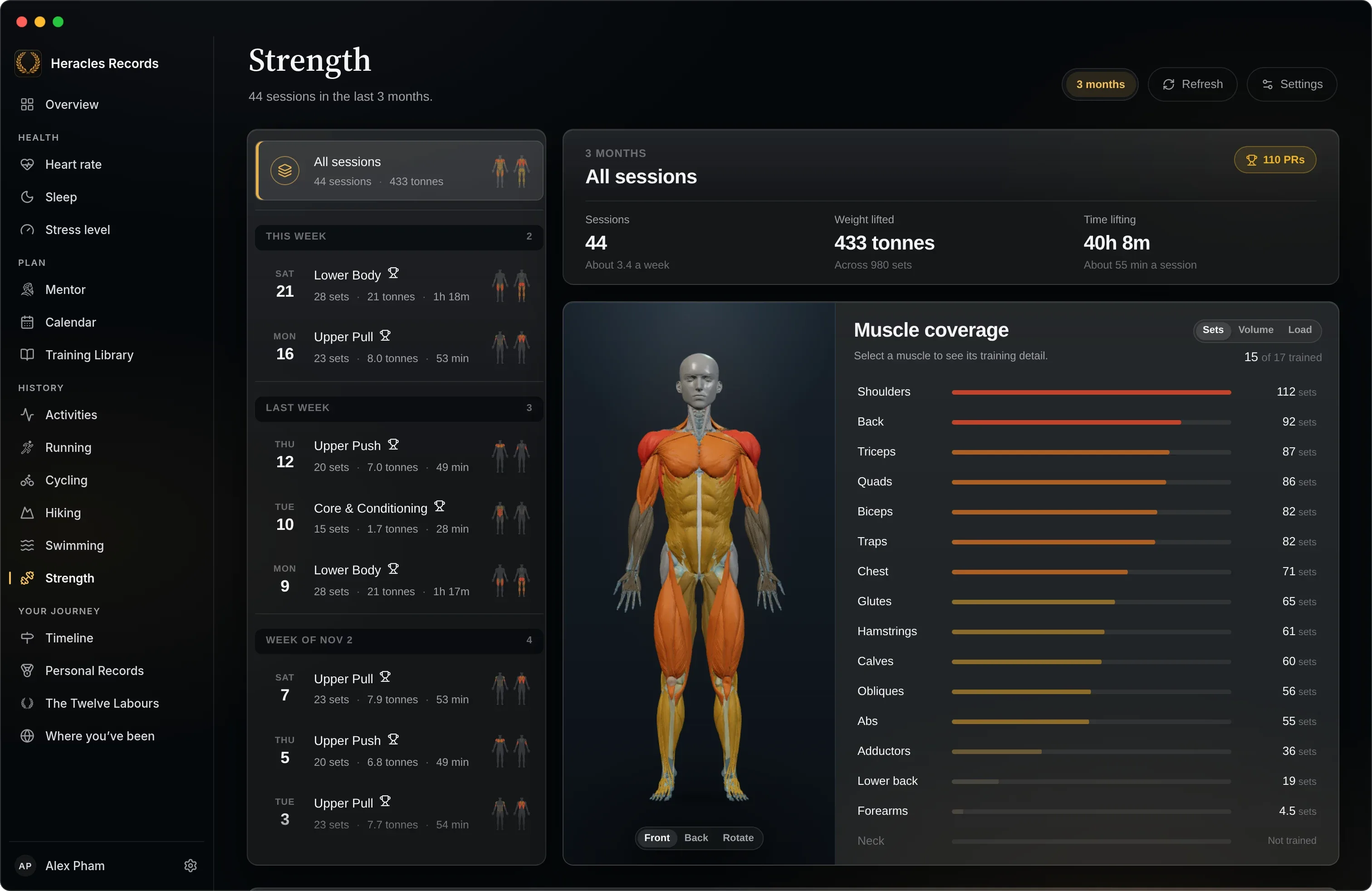
Every set, on the muscles it worked.
One session at a time, or the weeks around it, beside a 3D figure lit by what each muscle did. Turn the figure, pick a muscle and see its training.
- Sets, Volume or Load on the figure, and every muscle ranked by it.
- Muscle coverage: how many muscle groups the period trained, and which it left out.
- Records written in the exercise rows they were set in, and your main lifts across the window.
- Weekly sets, so a block's build-up and its deload are plain to see.
- Each set's effort and load, with Heracles TL chosen: how many reps it had left and what it added.
- Honest about gaps: sets COROS filed only as Full Body are left off the map, and the screen says how many.
Exercises Library
Every movement, described again.
The app reads a movement by what it is, never by its name, and describes each one again, its muscles and equipment one by one: the obliques for twists and side planks, the neck for neck work, a squat on the quads and glutes, a battle rope on the shoulders. Where it disagrees with COROS, that is on purpose, and your totals and Mentor read the right muscles.
Browse the Exercises Library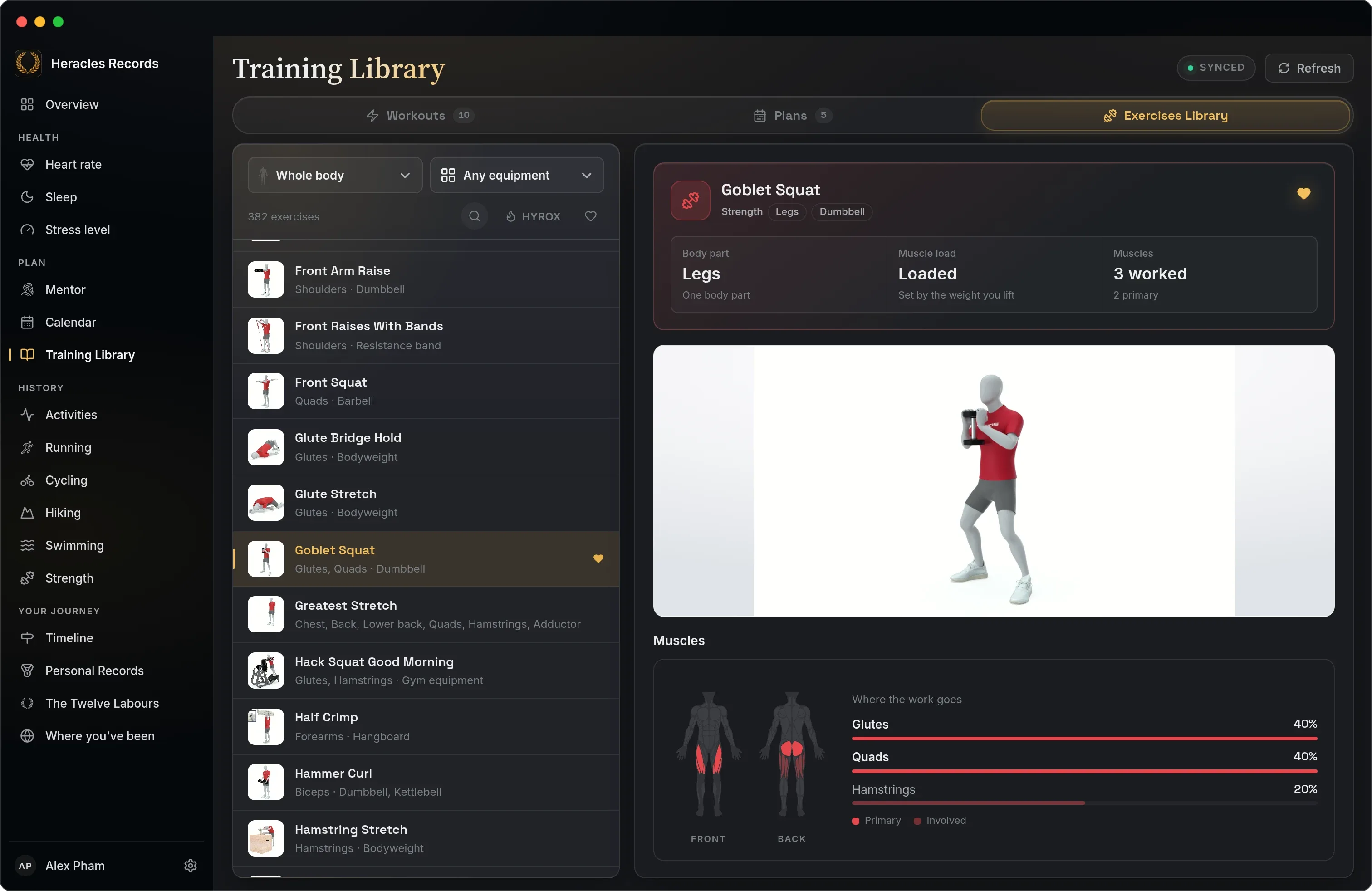
Hevy
Your Hevy workouts, beside COROS's.
Connect Hevy and its workouts join your COROS sessions on the same screen. A session recorded in both is merged into one, a Hevy movement is scored like its COROS twin, and the RPE you log for a set in Hevy is used over any guess. Choose whether warm-up sets count.
Connect HevyAsk Mentor about a session.
Mentor reads every set, its weight and reps, and with Heracles TL chosen the load of each session. Ask whether last week's lifting left room for Sunday's long run, and the answer weighs both.
How Mentor worksHeracles Training Load
Every set, counted for what it cost.
A strength session measured by the work in it: the weight, the reps, your body weight and the most you have lifted on each exercise. Each set is scored by how close to failure it went, so your week's load, your fitness and your recommended range count the gym for what it really took.
Why heart rate is not enough
2-3× too low
A strength session read by heart rate counts two to three times lighter than it felt.
A hard set lasts half a minute. Heart rate climbs after it and falls through the rest, while the muscles do work the heart barely sees. A load read from heart rate, COROS's TRIMP, misses most of it.
PMData: weights sessions rated 5 to 7 out of 10, beside the heart rate the watch recorded. Over ten real sessions read set by set, Heracles TL came to about 2.4 times COROS's figure.
- Read by heart rate 0.55-0.8
- Heracles TL 1.35-1.84
The formula
Every minute, charged by its effort.
Heracles TL = max(COROS TL1, Σ f(RPE)2 × set minutes3 + f(1.5) × minutes between sets4 )
f(RPE) = h × 0.2445 × e3.411 h
h = 0.48 + 0.031 × RPE
-
COROS TL
The floor. A session never scores less than COROS gave it: COROS's part is the cardio, what Heracles adds is the muscular work.
-
f(RPE)
What a minute weighs: COROS's own TRIMP weighting, at the share of heart-rate reserve a steady effort at that rating usually reaches.
-
Set minutes
The work and the rest after it, up to three minutes: the time a set holds you at its effort.
-
Minutes between sets
The warm-up, changing lifts, stretching, a watch left running, all at RPE 1.5, very easy.
One set, step by step
What one set of bench press weighs.
A 75 kg athlete benches 70 kg ten times, then rests 2 minutes.
-
The set
70 kg × 10
What it moves: the weight, plus the share of your body the movement lifts.
-
Your max
96 kg for one rep
Implied by your best set in 120 days, 80 kg × 6, taken as two reps short of failure.
-
Reps in reserve
3.4 at 73% of max
Reps to failure at that share of your max, from a meta-regression of 7,289 people (Nuzzo 2024), less the reps done.
-
Effort
6.8 RPE
Reps in reserve on the 0 to 10 scale lifters rate a set by (Zourdos 2016).
-
Load
4.4 TL
f(6.8) for the set's 2.5 minutes of work and rest.
-
One formula, from research
Every constant is published, or fitted on many people. None is tuned on your own data.
-
Measured against your strength
Each set is judged by how close to failure it went for you, from the most you have lifted on that exercise.
-
Open to checking
Every step, source and known limit is written out, and the fit is a script in the app's source, ready to run again.
Built on Nuzzo 2024, Zourdos 2016, Helms 2016, Steele 2017, Foster 2001 and PMData 2020.