 Heracles Records
Swimming
Length by length.
Pool swims and open water, read the way a swimmer thinks about them: a pace per 100, a week in metres, Critical Swim Speed as the pace you hold for a long set, and SWOLF as the measure of how much each length costs you.
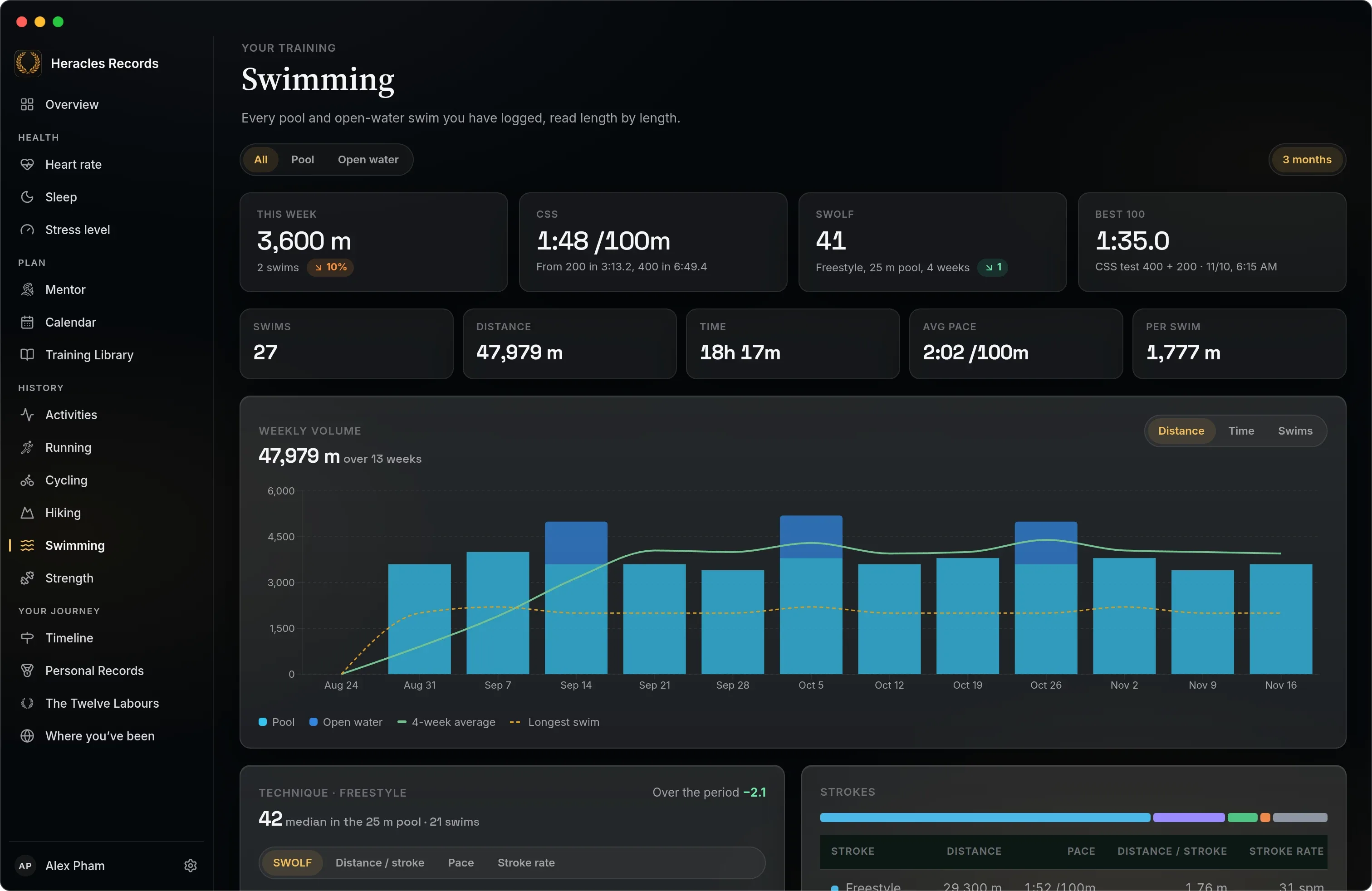
The screen
A swimmer's numbers, not a runner's.
- Pace per 100 m, or per 100 yd, never per kilometre, over the swimming with the rests at the wall left out.
- Critical Swim Speed from your fastest freestyle 200 and 400 swum without stopping, as a CSS test works it out.
- SWOLF, seconds plus strokes a length, read in one length of pool at a time: a 50 m length has one turn fewer.
- Technique over time: SWOLF, distance per stroke, pace and stroke rate, each swim a dot and a median line through them.
- Your strokes: how far you swam freestyle, backstroke, breaststroke, butterfly and drills, and how each went.
- Pool and open water apart or together, a week at a time in metres.
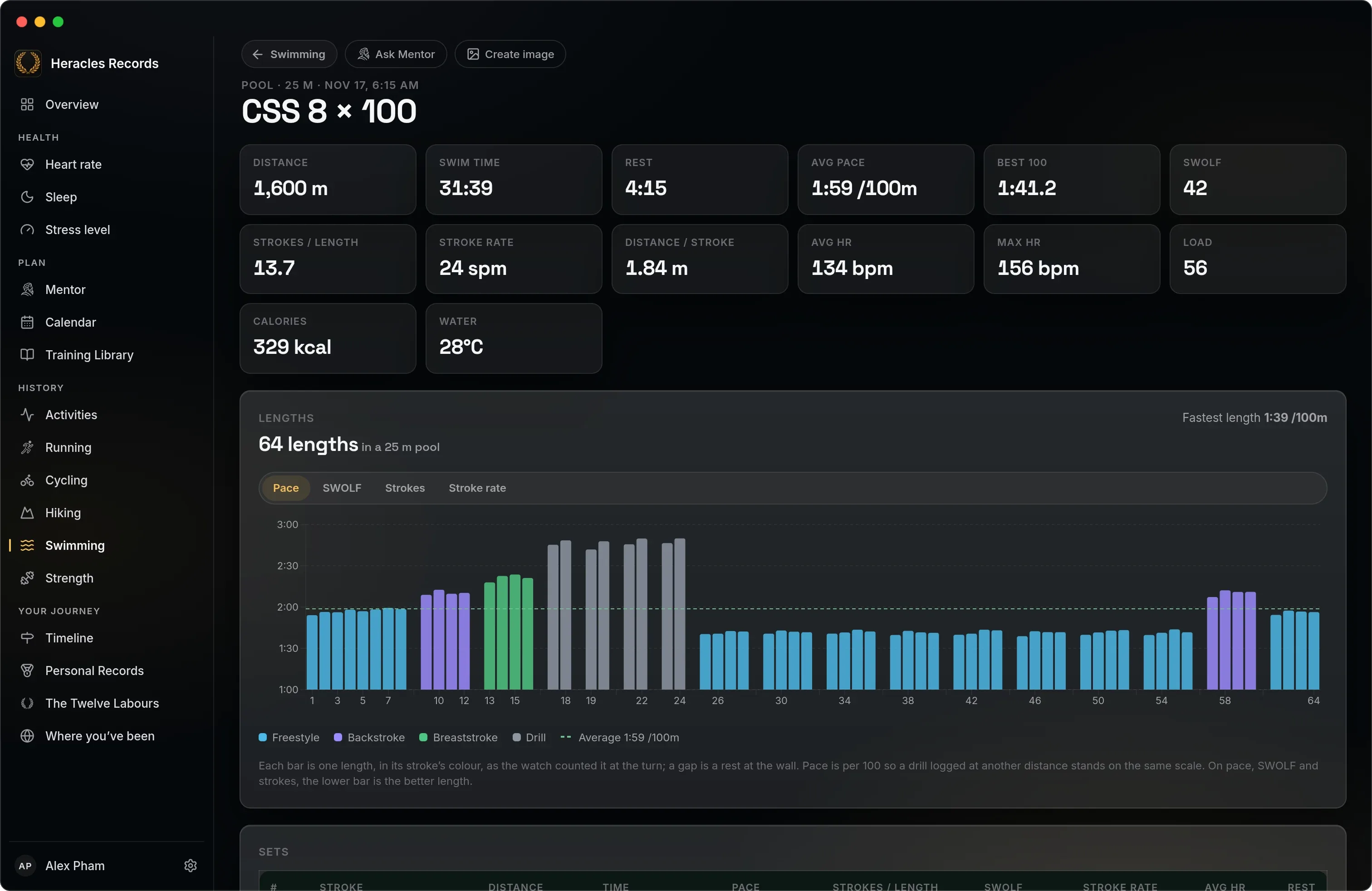
A swim's page
Every length, as the watch counted it.
- A bar for every length in its stroke's colour, by pace, SWOLF, strokes or stroke rate, with the rests as gaps.
- Swim time apart from rest, and the pool, found from the lengths: 25 m, 50 m, 33⅓ m or 25 yd.
- Strokes a length, stroke rate and distance per stroke: speed is the last two multiplied, so you see how a faster swim was bought.
- Your best 100, 200 and 400 inside the session, freestyle without a rest.
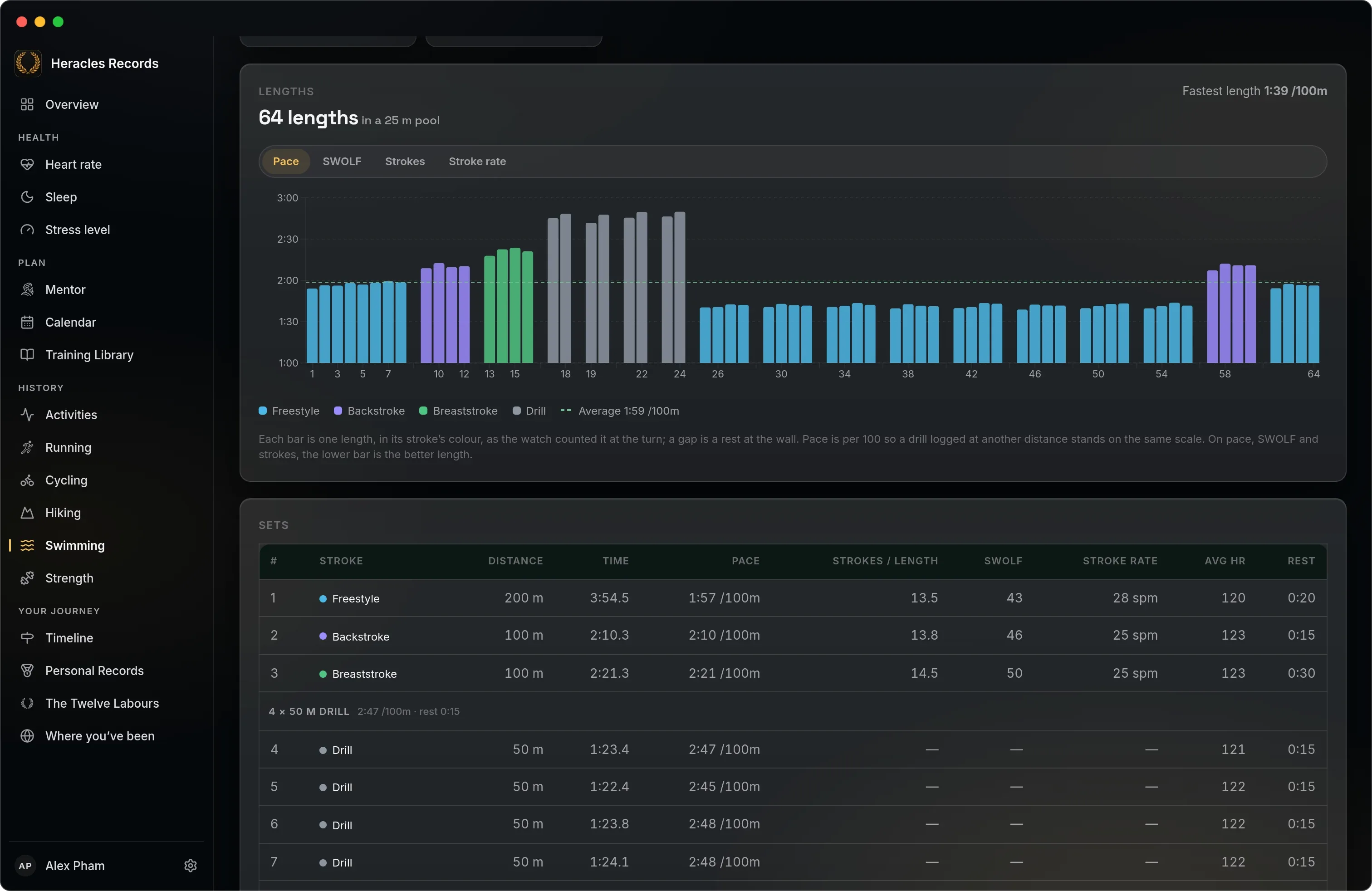
Sets
Written the way the board was.
The intervals you swam between rests are grouped into the sets they made, 8 × 100 m freestyle on 15 seconds, with each one's pace, strokes, SWOLF, stroke rate, heart rate and the rest after it. An open-water swim gets its route on the map, its pace and heart rate over time, and the watch's laps.
Heart rate reads low in the water.
Lying flat in cool water, your heart beats slower than it does on land, and a wrist reads it roughly while the arm is moving. So the screen leans on pace, strokes and SWOLF, and keeps the zones on each swim's page for what they are.